





Meaning of the word (Tae Kwon Do)
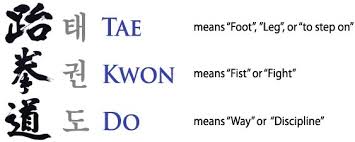
"Taekwondo is an empty-hand combat form that entails the use of the whole body. Tae means "to Kick" or "Smash with the feet," Kwon implies "punching" or "destroying with the hand or fist," and Do means "way" or "method." Taekwondo thus, is the technique of unarmed combat for self defense that involves the skillful application of techniques that include punching, jumping kicks, blocks, dodges, parrying actions with hands and feet. It is more than a mere physical fighting skill, representing as it does a way of thinking and a pattern of life requiring strict discipline. It is a system of training both the mind and the body in which great emphasis is placed on the development of the trainee's moral character."
Taekwondo Origin
"The earliest records of Taekwondo practice date back to about 50 B.C. During this time, Korea was divided into three kingdoms: Silla, which was founded on the Kyongju plain in 57 B.C.; Koguryo, founded in the Yalu River Valley in 37 B.C.; and Paekche, founded in the southwestern area of the Korean peninsula in 18 B.C.." (2) Tae Kyon ( also called Subak) is considered the earliest known form of Taekwondo. Paintings from this time period have been found on the ceiling of the Muyong-chong, a royal tomb from the Koguryo dynasty. The paintings show unarmed people using techniques that are very similar to the ones used by Taekwondo today.
Although Taekwondo first appeared in the Koguryo kingdom, it is the Silla's Hwarang warriors that are credited with the growth and spread of Taekwondo throughout Korea. Silla was the smallest of the three kingdoms and was always under attack by Japanese Pirates. Silla got help from King Gwanggaeto and his soldiers from the Koguryo kingdom to drive out the pirates. During this time a few select Sillan warriors were given training in Taek Kyon by the early masters from Koguryo. The Taek Kyon trained warriors then became known as the Hwarang. The Hwarang set up a military academy for the sons of royalty in Silla called Hwarang-do, which means "The way of flowering manhood." The Hwarang studied Taek Kyon, history, Confucian Philosophy, ethics, Buddhist Morality, and military tactics. The guiding principles of the Hwarang warriors were loyalty, filial duty, trustworthiness, valor, and justice. (3) The makeup of the Hwarang-do education was based on the Five Codes of Human Conduct written by a Buddhist scholar, fundamental education, Taek Kyon and social skills. Taek Kyon was spread throughout Korea because the Hwarang traveled all around the peninsula to learn about the other regions and people.
Taekwondo is a martial art that in "todays" form of self defense has evolved by combining many different styles of martial arts that existed in Korea over the last 2,000 years and some martial arts styles from countries that surround Korea. Taekwondo incorporates the abrupt linear movements of Karate and the flowing, circular patterns of Kung-fu with native kicking techniques. Over fifty typically Chinese circular hand movements can be identified in modern Taekwondo. (1) A few of the earlier martial arts styles that contributed to Taekwondo are: T'ang-su, Taek Kyon, also known as Subak, Tae Kwon, Kwonpup and Tae Kwonpup. There are also influences from Judo, Karate, and Kung-fu.
Weaponless martial art during the Three Kingdoms period
According to the history, Three Kingdoms Much attention(????) philosophy, martialism(????) with emphasis on Three Kingdoms period, and various martial arts were developed. Goguryeo was a strong state in Northeast Asia with strong military power, and their martial arts were well developed. For example, the techniques of archery, swordsmanship, and spears were developed in Goguryeo. The types of weapon systems of Goguryeo are recorded in history such as Anak Tomb No. 3. In Baekje,In Baeje, a weaponless martial art was developed as shown by the figurine in Baekjegeumdongdaehyeongno, a splendid gilt-bronze incense burner and Subak, fencing, horse-riding, Dukgyeoni, Kagumjil, and Sssireum were developed in Shilla.
A weaponless martial art during the period of Goryeo dynasty
Weaponless martial arts were developed in Goreyeo dynasty. Many military officers had to train in weaponless martial arts such as Subak, Subakhui, Obyungsubakhui, and Byungsu because this was related to the hiring process of government offices and promotions. A description of Subak is as follows; Yi Ui-min who was good at Subak, competed to show his power.A weaponless martial art during the period of Joseon dynasty
Weaponless martial arts such as Subak, Subakhui, Kwonbub, and Taekkyon were propagated during the Joseon Dynasty period, but these was developed as leisure activities or games, to hide their military martial art aspects.The records mentioning Subak in annals of the Joseon dynasty were in the early part of the period, but records in which Kwonbub appears were in the latter part of the period, after Imjinwaeran, in the Guhyosinseo and Muyedobotongji.
Taekwondo Today('60s)
Korean martial arts could not be practiced because of the regulations against that activity and the policies of repression of the Japanese government during the Japanese colonial period.After achieving independence, some leaders of Taekwondo tried to secure their own legitimacy and improve Taekwondo after August 15th, National Liberation Day. After achieving independence, modern Taekwondo Dojangs appeared, such as Chungdoguan, Songmuguan, Mudukguan, Joseon Yeonmuguan kwonbubbu, and the Central YMCA Kwonbubbu, and the instruction of techniques began.
The Korea Taesudo Association was founded on September 16th, 1961. Later, the name of the Korea Taesudo Assocication was changed to the Korea Taekwondo Association.
Taekwondo Today('70s)
Kukkiwon was founded as the KTA(Korea Taekwondo Association) central Dojang on Novermber 30th, 1972, and since then has played an important role in the distribution and perpetuation of the tradition of Taekwondo. The 10 Dojang derived from 5 Dojang, and then these were united into one organization according to the decision of the committee members of Taekwondo Main Center in 1978. Kukkiwon devotes itself to spread Taekwando culture, spirit and history worldwide, increasing the best competitive power of Taekwando as a martial art in life.Taekwondo Today('80s)
n the 1980s, the association focused on the universities, especially the university departments or majors. The alumine of Taekwondo were very influential in the drafting Taekwondo's policies and, thus, its development.To date, Taekwondo Department have been founded in 60 universities. Taekwondo major is also accepted in universities of many foreign countries.
Taekwondo Today('90s)
Taekwondo became a demonstration sport on September 17th, 1988 in the 24th Seoul Olympics, and this became a bridgehead to spread Taekwondo world wide.
Taekwondo became an official Olympic sport at the 103th IOC Assembly in Paris, France. The Korean Language become an official language of the Olympic Games, joining English, French, and Japanese. Taekwondo is now an international martial art in 203 countries, and includes 80 million practitioners.
Taekwondo of Mantkd
Mantkd Taekwondo Academy is rooted in the practice of traditional Taekwondo techniques and practice, wearing traditional Doboks, training in all areas of Kyorugi (Sparring), Poomsae (Patterns) and Hosinsul (Self defence). All our gradings are focused on the pattern itself and sourronding techniques, demonstrating a full and complete practice of Taekwondo.